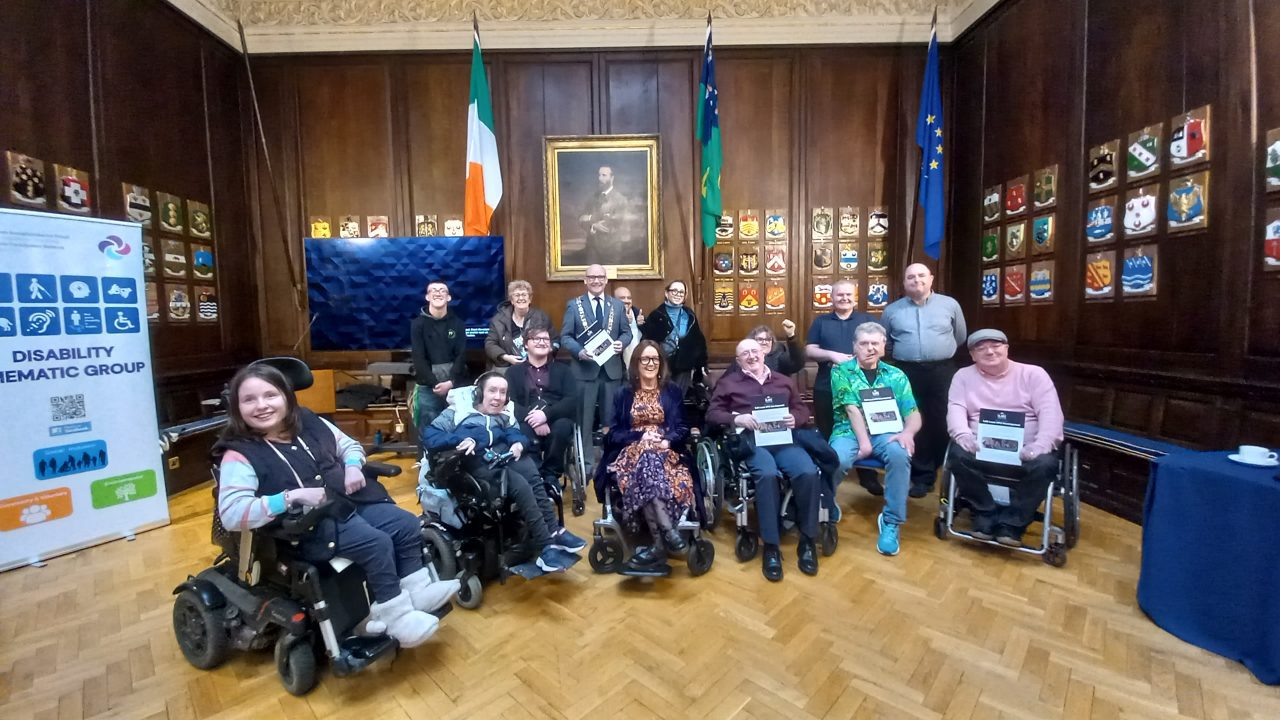
On Wednesday, 25 February, the Round Room at the Mansion House was the setting for the launch of the Dublin City and County Disabled Persons’ Organisation (DPO). Hosted by Lord Mayor, Cllr Ray McAdam, the event marked a significant moment in the ongoing development of inclusive civic participation and representation in Dublin.
A Disabled Persons’ Organisation (DPO) is a representative body that is led, controlled and governed by disabled people. Unlike charities or service-providing organisations, which may work for or alongside disabled people, a DPO is rooted in the lived experience of its members and advocates from that standpoint. Under the principles of the United Nations Convention on the Rights of Persons with Disabilities (UNCRPD), DPOs are designed to express, promote and defend the rights and interests of disabled people in public policy and decision-making, ensuring that “nothing about us is decided without us”.
The launch on 25 February was not a spontaneous event but the culmination of around a year’s partnership between Independent Living Movement Ireland (ILMI), and the Public Participation Network’s (PPN) Disability Thematic Group (DTG). Over the past twelve months these groups worked collaboratively to explore how a Dublin city and county DPO could be established in a way that aligned with both the lived realities of disabled people and the PPN’s participatory structures. That groundwork provided a shared foundation of values, experience and organisational insight which informed the DPO’s formation.
Although now formally launched, the Dublin City and County DPO will apply to join the PPN through the standard membership process. Once successfully admitted as a PPN member organisation, it will be entitled to nominate and elect representatives to Strategic Policy Committees (SPCs) and the Local Community Development Committee (LCDC), through which it can influence local governance and policy in areas such as accessibility, transport, housing and community development. This procedural step reflects the PPN’s established governance norms, designed to ensure transparency, accountability and broad community participation.
There is already close continuity between the new DPO and the PPN’s existing disability structures. The DPO committee members Mick Keegan, Martin Hoey and Sandra Dillon are themselves active within the PPN Disability Thematic Group, meaning the new organisation builds directly on existing expertise and networks rather than starting in isolation.
At the launch, Lord Mayor Ray McAdam welcomed the establishment of the DPO and spoke of the importance of ongoing dialogue between Dublin City Council (DCC) structures and representative groups within the PPN. He encouraged sustained engagement aimed at improving the city’s accessibility, inclusiveness and responsiveness to disabled people’s needs.
In Ireland, several national DPOs already exist that operate at a wider level, some of which have presence or representatives in Dublin. The DPO Network is alliance of organisations committed to advancing CRPD implementation and includes members such as AsIAm (Ireland’s national autism advocacy organisation), Disabled Women Ireland, Independent Living Movement Ireland (ILMI), the Irish Deaf Society and the National Platform of Self Advocates. Other organisations that operate with a DPO identity within the PPN, include Voice of Vision Impairment (VVI), and Physical Impairment Ireland. These groups exist alongside a broader landscape of disability-focused charities and advocacy bodies whose structures and mandates vary.
The launch of the Dublin City and County DPO at the Mansion House was therefore both a recognition of past collaboration and a step toward deeper, structural participation within Dublin’s civic framework. With its pending PPN application and experienced committee, the DPO is poised to strengthen the disability voice in local policy forums and contribute to more inclusive decision-making.